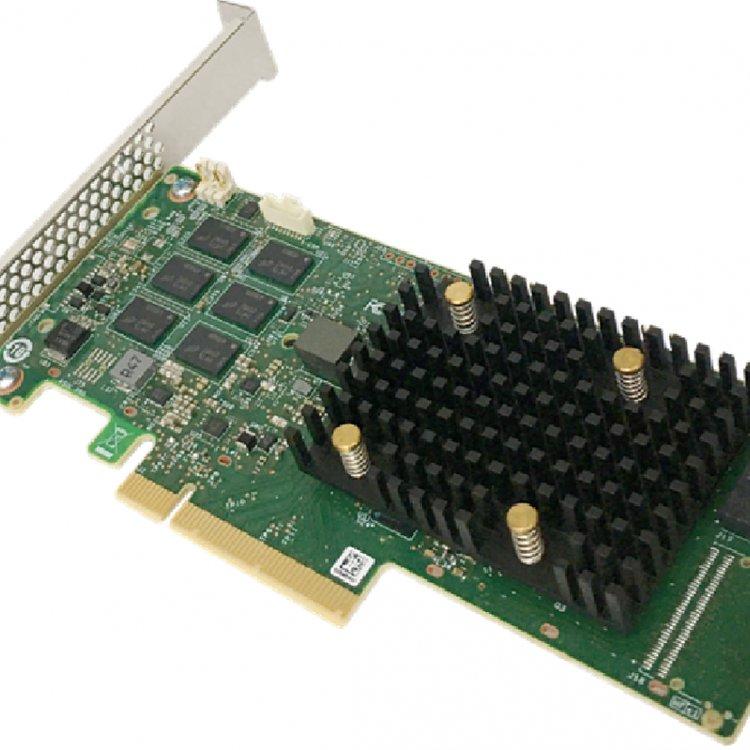
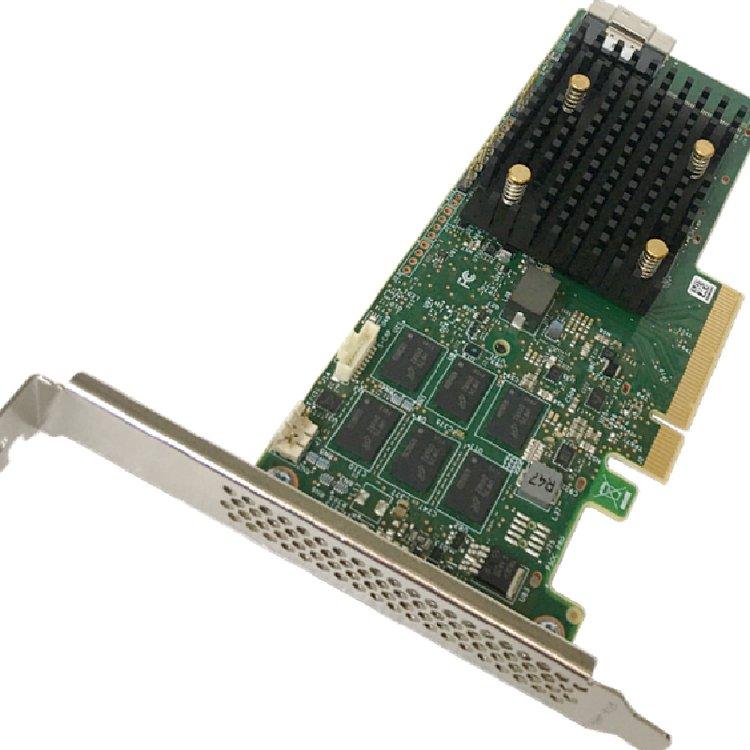
Array cards are core components used in servers and high-performance computing scenarios to manage multiple hard drives. Through hardware-level RAID (Independent Disk Redundancy Array) functionality, they enhance data storage reliability, read/write speeds, and capacity expansion. Its core function is to virtualize multiple physical hard drives into logical storage units, supporting different levels of RAID modes (such as RAID 0/1/5/10), meeting needs for data backup, performance acceleration, or capacity stacking. Taking the Broadcom 9560-8i array card as an example, these products integrate dedicated processors and cache modules to significantly reduce the storage management load on server CPUs, making them especially suitable for scenarios with stringent storage performance requirements, such as databases, virtualization, and video editing.
1. Technical Principles and Core Components:
The working principle of the array card is based on a hardware-level RAID engine, with core components including the RAID controller chip, cache module, interface circuits, and firmware algorithms. Take the 9560-8i as an example: its SAS3916 chip supports SAS/SATA dual protocols, allowing simultaneous connection of mechanical hard drives and solid-state drives, with compatibility covering enterprise-level storage needs; 4GB of dedicated cache uses prefetch and data buffering technology to reduce disk addressing latency and improve random read/write performance; The PCIe 3.0 x8 interface ensures that data transfer bandwidth matches the server motherboard, avoiding bottlenecks. Additionally, the card supports the NVMe protocol, allowing direct management of NVMe SSDs and further unlocking storage performance potential.
2. Key Parameters and Selection Logic:
When choosing an array card, pay special attention to three key parameters: interface protocol, cache capacity, and RAID level support. Interface protocols determine compatibility. For example, SAS/SATA dual-protocol cards can accommodate more types of hard drives, while NVMe*** cards are optimized for high-speed SSDs; Cache capacity directly affects performance. 4GB of cache is sufficient for most enterprise-level applications, but for high-load scenarios like video rendering, 8GB or more is recommended; RAID-level support must match business needs. For example, RAID 1 provides data mirror redundancy, RAID 5 balances performance and security through distributed verification, and RAID 10 combines the strengths of both. Taking the 9560-8i as an example, it supports RAID modes 0/1/5/6/10/50/60, covering diverse needs from basic backup to high-availability architectures.
3. Usage Scenarios and Key Deployment Points:
The application scenarios for array cards are mainly divided into three categories: data security-first (such as financial and healthcare systems), performance-first (such as virtualized clusters, databases), and capacity-first (such as video archiving, big data analytics). During deployment, hardware compatibility should be considered, for example, ensuring the server motherboard supports PCIe 3.0 x8 slots and that the power supply is sufficient to drive multiple hard drives; Firmware updates must be obtained through official channels to avoid stability risks caused by unauthorized modifications; During routine maintenance, regularly checking the cache battery status (if equipped) can prevent data loss caused by sudden power outages. For enterprise-level products like the 9560-8i, its "store three-guarantee" after-sales service provides basic technical support, but complex faults still rely on a professional operation and maintenance team.
4. Technical Advantages and Practical Performance:
Compared to software RAID (CPU-dependent computation), hardware array cards have advantages in low latency and high reliability. Taking the 9560-8i as an example, its dedicated RAID chip can independently handle storage tasks, freeing up server CPU resources for core business; Hardware-level verification algorithms reduce data error rates, making them especially suitable for 7×24/7 continuous operation scenarios. Actual data shows that with 8 SSDs forming RAID 0, sustained read/write speeds can exceed 12GB/s, approaching the theoretical bandwidth limit; In RAID 5 mode, the rebuild time for a single hard drive failure is shortened by more than 60% compared to software RAID, significantly reducing the risk of service interruptions. These features make it a core storage component for scenarios such as data centers and cloud computing.